
Topics discussed in this article:
- What is memory, encoding, storage, and retrieval?
- What are the 4 types of memory?
- What is spreading activation and semantic networks?
- What does retrieval mean in memory?
- How do emotions affect our memories?
- What are some memory related disorders?
- What is the decay theory and interference theory of forgetting?
- What is the relationship between memory synaptic connections and learning?
Memory
Memory is the ability to process information from our senses and experiences, to store it, and to be able to recall that same information at a much later time, or at a short time later. This section will cover topics related to how the human brain encodes information, processes helping memory encoding and storage, and how memories are retrieved. In addition, this section will cover the process of how memories are lost over time, how forgetting works in the human brain, and how changes in the brain can affect memory and learning over the course of the human lifetime.
Encoding
Encoding refers to the first stage of using new information to create a new memory. This process allows stimuli or bits of information to be converted into a construct that the human brain can store for long periods of time. This process of encoding information is what allows the future recall of memories. Without encoding, humans experiences and information will not be stored in the brain and will not be able to be recalled later. A simple way to think of the way that humans experience and are exposed to new information is to think about opening a new file on a computer—without clicking “save,” that file will be lost forever, but if saved, the file can be selected and pulled up at a later time.
Process of Encoding Information
Encoding begins with perception. Perception is the process through which we identify, organize, and interpret external sensory stimuli that is relayed from the peripheral nervous system to the central nervous system (CNS). In the CNS, or the brain, these stimuli are relayed to their respective centers. The combination of stimuli are culminated into one experience, and if these culminations of stimuli or events reach the hippocampus, the experience is stored as a memory. While this is a very general summary of how memories are encoded, it’s important to also note that there are different ways of encoding meanings of information. These include:
- Visual encoding: storing and remembering imagery and visual information (the weakest type of encoding)
- Acoustic encoding: storing and remembering auditory stimuli or information based on the way it sounds.
- Semantic encoding: the strongest and most durable type of encoding—storing the meaning of information by putting information into a meaningful context. This is the strongest type of encoding because of vivid context will enhance memory, and because of the self-reference effect, in which one’s brain encodes information differently depending on how one implicates themselves in its semantic encoding.
- Elaborative encoding: using previously known information and relating it to new information in the present experience for better memory.
Processes That Aid in Encoding Memories
There are a few processes that can help consolidate and encode memories into long term memory. These include maintenance rehearsal, mnemonics, and chunking. Maintenance rehearsal is the process of repeating a piece of information to maintain it in working memory. This facilitates its encoding into short term memory, and eventually long-term memory. Mnemonics are a learning and memorization technique that uses acronyms or rhyming of phrases to organize information. Using the method of loci (a mnemonic) allows a person to learn and memorize information by associating pieces of information with one location along a route of spatial location in the environment. Similarly, the peg word system is a mnemonic technique that associates numbers with items or pieces of information that rhyme or sound similar to the numbers they are paired with. The third method to aid in memory encoding is called chunking, but it is often referred to as clustering. Chunking is the process by which one takes individual pieces of one large list and grouping them together based on related meanings.
Storage
Storage is the process of encoding information to be remembered later or in the long term, as the creation of a permanent record, or memory, of the encoded information.
NEEDS ORIGINAL COPY ^^
Types of memory storage
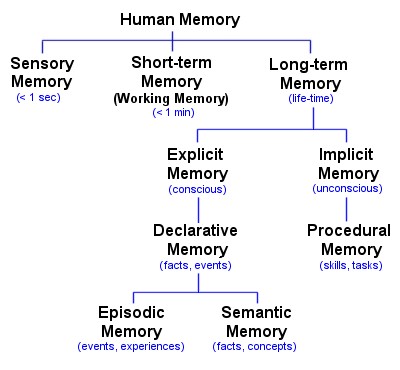
Just as there are different types of encoding, there are also different types of memory storage: sensory memory, short-term memory, working memory, episodic memory, and long-term memory.
| Description | |
|---|---|
| Sensory Memory |
Sensory memory is a type of memory that is brief and based on sensory impressions. Sensory memories consist of brief memories that are less than one second long, but with detailed representations. There are two kinds of sensory memories: iconic/visual and echoic/auditory memories that are stored in the main projection areas of each sensory system encoding them. For example, visual memories will be stored with their visual information in the occipital lobe and auditory memories will be stored with their accompanying auditory stimuli in the temporal lobes. Unless attended to immediately, information of sensory memories will diminish quickly. |
| Short-Term Memory (STM) | Short-term memory (STM) is memory that attends to the current sensory information that one is thinking about or still processing. STM lasts about 30 seconds, quickly fades without maintenance rehearsal, and is limited to 7±2 items (referred to as the 7±2 rule). Previously mentioned as a pneumonic, clustering can also help increase the capacity of the amount of information that can be held in STM. The main processing center of STM is the hippocampus, which is also the area of the brain that consolidates STM into long-term memory. |
| Working Memory | Working memory is a type of STM that processes immediate stimuli, withholds it, and can manipulate information. Working memory integrates STM, attention, executive function, and other cognitive processes, such as mental calculations and considerations. Working memory is supported by the hippocampus, the frontal, and the parietal lobes of the human brain. |
| Long-Term Memory (LTM) | Long-term memory (LTM) is a type of memory where information is processed from short-term memory to a longer term capacity that still allows information to be recalled on demand. The process of encoding information into LTM requires a process called elaborative rehearsal. Elaborative rehearsal is a method through which one associates new information to previously acquired knowledge, or information already stored in our LTM to consolidate new memories and store them permanently. This process is very similar to the self-reference effect, an effect that allows experiences to be stored into LTM because new ideas are more relatable to one’s own experiences. Similar to STM, LTM is processed by the brain’s hippocampus before memories are associated with information in the cerebral cortex. |
|
Implicit memory (non-declarative or procedural) is an unconscious memory of skills and conditioned responses. |
|
|
Explicit memory (declarative) is a memory that requires conscious effort for recalling information from that memory.
|
Semantic Networks and Spreading Activation
Semantic networks and information are connected together based on similar meanings. In a semantic network or a frame network, nodes are specific ideas or experiences that are stored in a neural network that bridge the relationships between ideas and other memories. Nodes are connected through associating ideas and are activated through adjacent neural signals. When enough nearby signals are activated to associate nodes (such as ideas, linked memories, small characteristics relating to the memory, etc), this process is called summation. Spreading activation is a cognitive process when a node of a semantic network is activated and therefore unconsciously activates and reinforces linked concepts.
Retrieval
Recall, Recognition, and Relearning
Recall is the cognitive process of remembering information. There are three types of recall:
- Free recall is the process of randomly remembering information, usually without effort or without a cue related to the memory/information.
- Cued recall is the process through which a cue, question, or prompt allows a person to remember information.
- Serial recall is the ability to remember items, numbers, names, events, etc, in the order in which they occurred or were learned.
Recognition is the process of identifying a piece of information from related and previous knowledge, or a collection of information. Relearning is the process of re-memorizing information that was previously learned. This process usually results in faster learning than the first time around. The spacing effect shows that greater retention of information is achieved by using longer amount of times between sessions of relearning.
Retrieval Cues
Retrieval cues are prompts that aid in the recall of particular information or memories. An example would be if you tried a new ice cream flavor but couldn’t remember from where. If you tried to remember, you would search for retrieval cues such as the brand, the ice cream shop name, or the location.
The Role of Emotion in Retrieving Memories
Retrieval of memories can be facilitated or impeded by emotions that are associated with them. When someone learns new information while experiencing a particular emotion, the process and memory is known as a mood-dependent memory. Memories of these types are best recalled when the person experiences the same emotion. Emotion can also bias our memories. For example, a person’s mood can affect the way in which they reframe their existing memories—if someone usually has a positive association with a memory and their current mood is negative, they are more likely to skew their perception of their memory as negative as well.
Processes That Aid Retrieval
Similar to retrieval cues, there are several processes that help people remember information more easily. Priming is a retrieval cue that trains a person’s memory by spreading activation (see semantic networks). Context effects is a process that aids in memory retrieval when one is in the same physical location where encoding of that memory took place. For example, many students will tend to do better on exams if they take the test in the same location where they studied and learned the exam material. Similarly, the state-dependent memory effect is an effect where one is able to recall information better if their mental state resembles the same state as when they learned it.
Forgetting
Aging and memory
Aging is associated with, but does not always imply the occurrence of significant memory loss. Short-term memory is known to decline steadily after the age of 60, but free recall becomes difficult during our general aging process. Issues with recall and forgetting of memories is very closely linked to the loss of neurons or myelination of neurons in the brain. Older adults tend to have strong associations or recall with memories from their young adulthood. This phenomenon suggests that memory encoding is strongest during young adulthood and declines thereafter. However, older adults do not typically show a decline in skill-based memory or recognition, but they do show a decline in prospective memory. Prospective memory is the need to remember a future task. As humans age, prospective memory is typically one of the keystone types of memory that declines. Due to having larger semantic networks, older adults will impressively be able to recall and learn semantically meaningful information.
Memory dysfunctions
There are several brain disorders and conditions related to memory dysfunction.
| Description of Brain Disorder Related to Memory Dysfunction | |
|---|---|
| Alzheimer’s Disease |
|
| Korsakoff’s Syndrome |
|
| Agnosia |
|
| Huntington’s Disease |
|
Decay
Decay is the natural process through which memory recall begins to decline. Decline is not usually characterized by a brain disorder and occurs naturally to every aging adult. The Decay Theory hypothesizes that when long-term memories are not recalled very often, they will decay and the difficulty of their recall will increase. Biologically, the decaying process is characterized by the fading of neurochemical traces of short-term memories. The curve of forgetting shows the increase in difficulty of remembering information as people ages.
Interference
Interference, or the interference effect, is a memory phenomenon when similar information causes retrieval error. There are two types of interferences:
-
- Proactive interference occurs when information already learned interferes with the learning of new information. This makes the process of subsequent information more difficult to learn.
-
- Retroactive interference occurs when new information causes one to forget previously learned information. An example is the phenomenon that occurs when teachers get a new cohort of students and learned their names. Learning these new names will cause the teacher to have a difficult time remembering their old classmates’ names.
Memory constructions and source monitoring
Thoughts, emotions, and very particular situations during the event of recall can affect memories. A schema is framework that holds our memories together and helps us recall them. Schemas can skew information. Confabulation is a process and symptom of memory disorders—gaps in memories will tend to be filled with false information that can alter or skew the original memory. The misinformation effect happens when outside influences affect the recollection of events or information during the event of recall. The source-monitoring error is a type of memory error leading to the confusion of semantic and episodic memories. This error will lead someone to remember details of an experience or particular event while incorrectly attributing the context to which the details actually belong or were obtained from. For example, if one hears or watches a storyline on television and later recalls the storyline as their own or having happened to them or someone they know, they are committing the source-monitoring error.
Changes in synaptic connections underlie memory and learning
Neural plasticity
Neuroplasticity is the brain’s ability to form neural connections rapidly as a response to stimuli, new environments, or situations. Newborns are born with an excess of neurons. Neuroplasticity is the crucial process that forms and reorganizes neural networks and connections between neurons as newborns and infants learn. Neural networks are refined and as humans age, the brain undergoes synaptic pruning, a process that eliminates synapses between neurons of larger networks caused by weak neural connections. Synaptic pruning is actually beneficial to the brain, as it maximizes its efficiency and ability to process information.
Memory and learning
New memory formation begins as a sensory memory being held in the projection area of the perspective sensory modality. In other words, visual memories will be stored in the respective visual processing area of the brain. The same applies to all other sensory information. Sensory memory is extremely brief in duration and will not be stored in long term memory unless it is encoded, reinforced, and consciously maintained in short term memory for storage in the hippocampus of the brain and eventually relayed to the cortex.
Long-term potentiation
As we age, neurons can either undergo synaptic pruning or be bolstered if they hold strong connections between one another. This strengthening of synapses between neurons is called potentiation. When a neuron shows excitability over an extended period of time as a result of a patterned activation, its synapse will be strengthened as well. This is called long-term potentiation (LTP), and is often best remembered by the principle that “neurons that fire together, wire together”. There is also a process that causes the reverse effect of LTP, called long-term depression (LTD), that causes synaptic connections to weaken in strength.